SpringboardX is Now Up and Running!
SpringboardX got off to a flying start at the Springboard Forum organized in Dipoli in the beginning of October. Executives, researchers, entrepreneurs, and policymakers gathered to explore how Finland can accelerate innovation, strengthen resilience, and lay the foundations for future growth. The message was clear: we must be bolder — and SpringboardX can help us achieve that.
The discussions underscored a shared conviction: Finland has the talent, expertise, and ambition needed to succeed in a rapidly changing world. The challenge is to bring these capabilities together across organizational boundaries and turn opportunities into action.
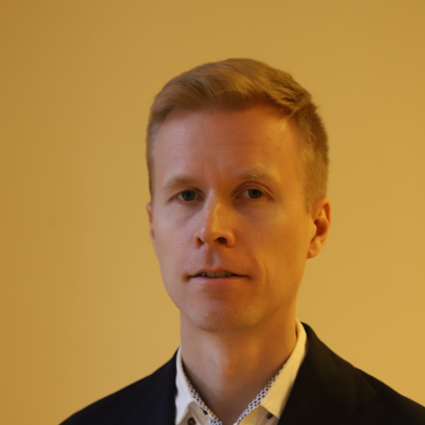
“The question is not whether change is coming.The question is whether we will lead it.”
Peter Lindgren, Vice President, System Drives, ABB, and Chair of SpringboardX
Peter Lindgren’s opening remarks captured the spirit of the forum. SpringboardX aims to catalyse collaboration across the public and private sectors to accelerate innovation and transformation.
“Finland has become the Texas of Europe, an innovation platform for physical AI.”
Teppo Rantanen, Chair of Business Finland
The keynote speeches highlighted Finland’s opportunity to drive growth and strengthen competitiveness through emerging technologies, industrial renewal, and innovation-driven productivity. Realizing this potential requires bold companies, strong research capabilities, and active collaboration across sectors.
“Success breeds further success. There’s a strong pipeline. So, we’re just getting started.”
Kristiina Mäkelä, Provost, Aalto University
The optimism surrounding Finland’s innovation ecosystem was evident throughout the day. Success stories in research, entrepreneurship, and ecosystem development are building momentum, attracting international attention, and laying the foundations for the next generation of high-growth ventures.
“The race for AI leadership is also a race to build secure, trusted, and resilient digital infrastructure. Here, we have a unique opportunity.”
Hanna Laurén, Head of Geopolitics and Government Relations, North Europe, Nokia
Nokia wants to support this development and help make Finland a platform for resilient digital infrastructure. This reflects the mission of SpringboardX: to create the connections, partnerships, and initiatives needed to transform ideas into action, networks into ecosystems, and opportunities into lasting impact. By aligning national policies with firm progressiveness SpringboardX will ensure the speed needed to drive transformational innovations.
Springboards Accelerating Transformations
Four panel discussions brought the SpringboardX approach into practice, exploring how collaboration between companies, academia and the public sector can accelerate transformation in areas where Finland has both strong capabilities and significant opportunities.
Accelerating the Energy Transition
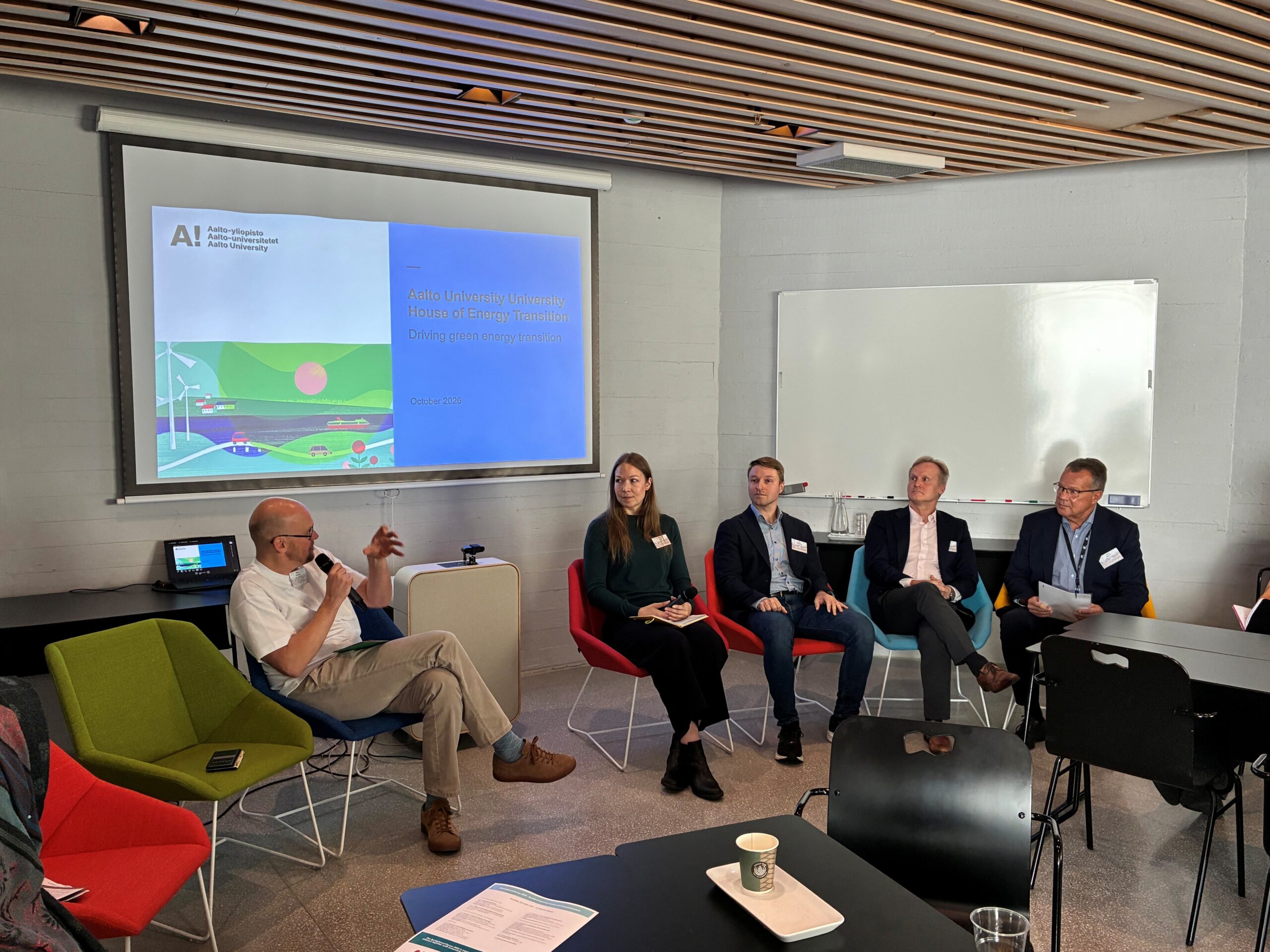
Panelists: Mika Järvinen, Associate Professor, Aalto University (moderator); Sanna Jokila, Head of Public Affairs, St1; Tapio Poutiainen, Director, Fortum; Panu Virolainen, CTO, Motion Business, ABB; and Jukka Mäkelä, Executive in Residence, Aalto University.
This panel explored how Finland can accelerate the energy transition while strengthening competitiveness, resilience, and security of supply. The transition requires major investments in energy production, transmission grids, storage, fossil-free fuels, and industrial infrastructure. At the same time, it presents significant opportunities in areas such as industrial electrification, renewable fuels, and the use of data centre waste heat. Espoo Clean Heat was highlighted as an example of how cities, companies, and research organizations can work together to develop and scale systemic solutions.
The discussion emphasized the importance of stable regulation, public-private testbeds, and stronger coordination between companies, cities, startups, universities, and public authorities. A portfolio approach is needed to balance near-term solutions such as biofuels with medium- and long-term opportunities such as hydrogen and fusion energy. SpringboardX can support this work by connecting ecosystems, facilitating knowledge sharing, and helping new solutions progress from research to industrial pilots and international scale.
Building the Future of Mobility
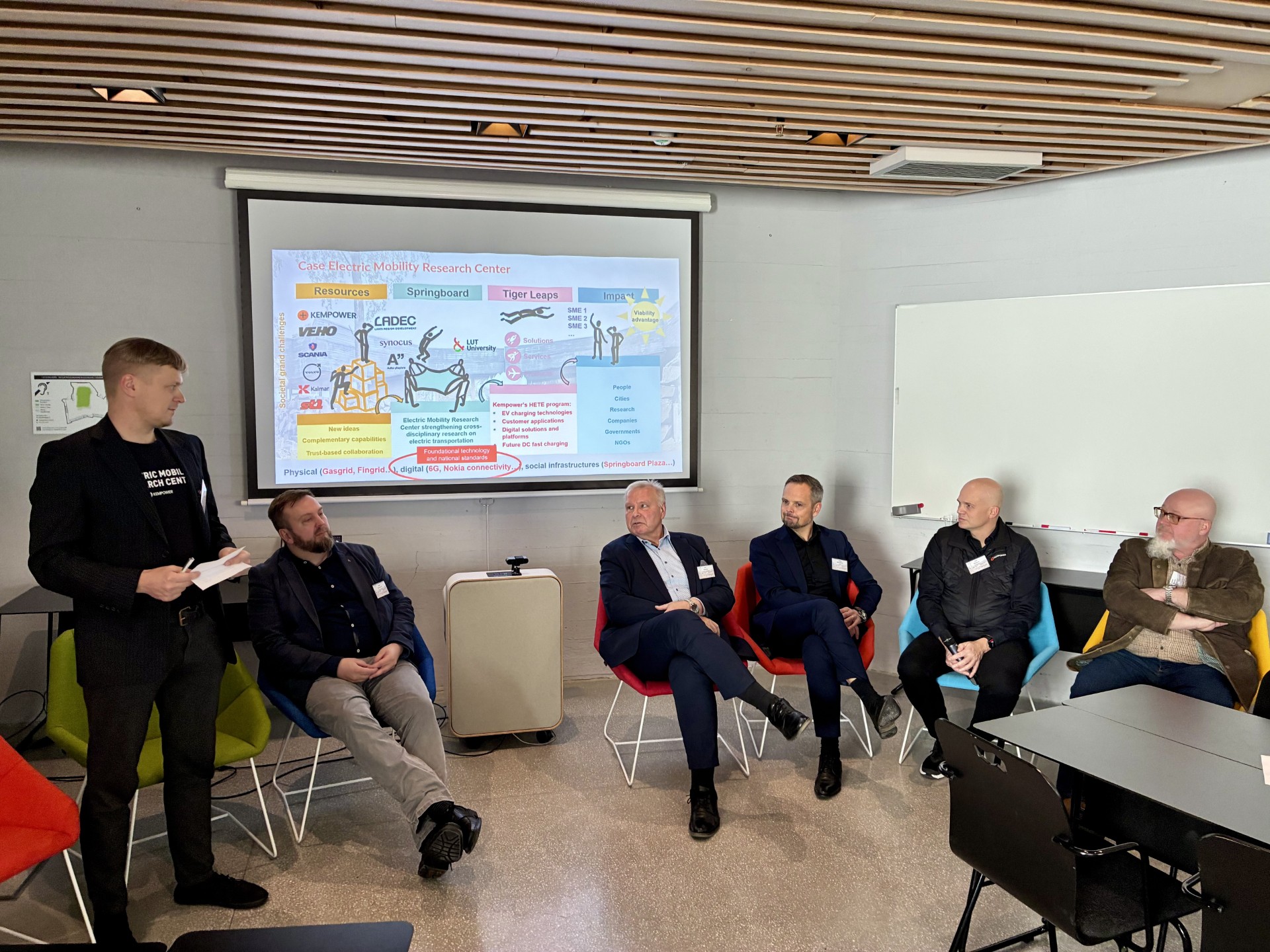
Panelists: Ville Naumanen, Director, Electric Mobility Research Center (moderator); Lassi Aarniovuori, Professor, LUT University; Ari Tolonen, Deputy Mayor, City of Jyväskylä; Janne Kämäräinen, Director, Cars, Veho; Erik Kanerva, Director, Kempower; and Jussi Harvela, CEO, TactoTek Group.
The mobility transition is accelerating as electric and hydrogen-based technologies mature and become increasingly commercially viable. Finland already has strong examples of ecosystem-based development, including the Electric Mobility Research Center established by Kempower and LUT University. In Jyväskylä, collaboration between the city, the University of Jyväskylä, Toyota, and the Toyota Mobility Foundation has created a test environment for hydrogen-based transportation.
The panel highlighted the need for more pilots, faster commercialization, effective regulation, and stronger international partnerships. This is particularly important in heavy-duty transport, where megawatt charging and hydrogen solutions are creating new possibilities. SpringboardX can help mobility ecosystems complement one another, share experiences, and connect Finnish research and industrial expertise with international partners and demonstration projects.
Transforming Kilpilahti
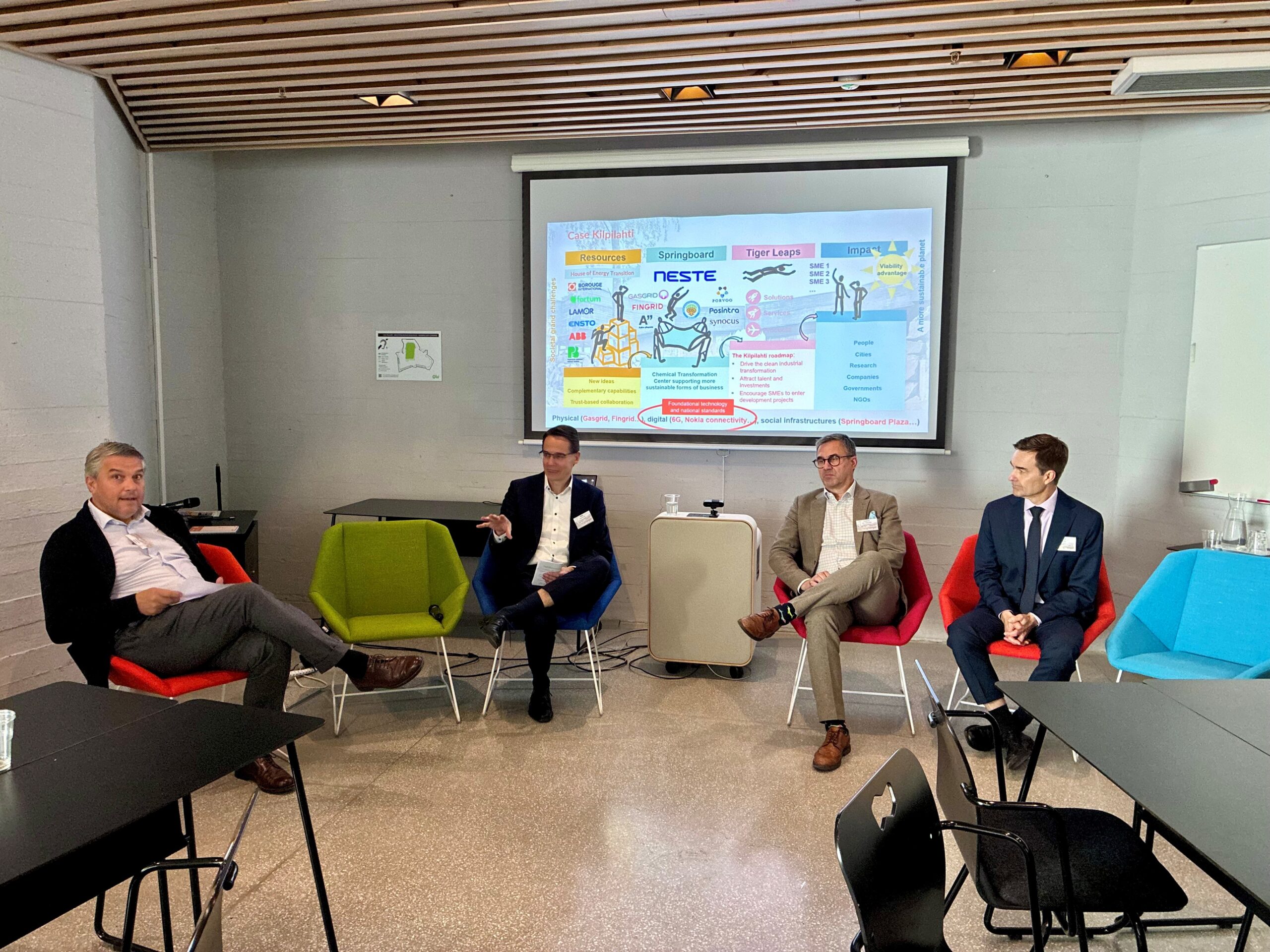
Panelists: Fredrik Pressler, CEO, Posintra (moderator); Måns Holmberg, CEO, Porvoon Energia; Fredrick von Schoultz, Deputy Mayor, City of Porvoo; and Antti Valle, Industrial Counsellor, Ministry of Economic Affairs and Employment.
The panel examined how Kilpilahti is going through a transition towards carbon-neutral production while remaining resilient and globally competitive. One of the central challenges is replacing fossil-based hydrogen with carbon-neutral alternatives during the 2030s. Achieving this will require market-driven investments, timely infrastructure decisions, and close coordination between companies, infrastructure providers, public authorities, and the City of Porvoo.
Kilpilahti has the potential to become a springboard for industrial transformation by building on its existing industrial expertise while developing new capabilities in green hydrogen, industrial symbiosis, and research collaboration. The City of Porvoo can support this development by bringing different actors together, reducing uncertainty, and creating an attractive environment for new companies and investments. SpringboardX can connect the lessons from Kilpilahti with experiences from other Finnish industrial ecosystems. This could influence national policies paving the way for Finland to become an international role model for industrial transformations.
Cultivating Transformational Forerunners
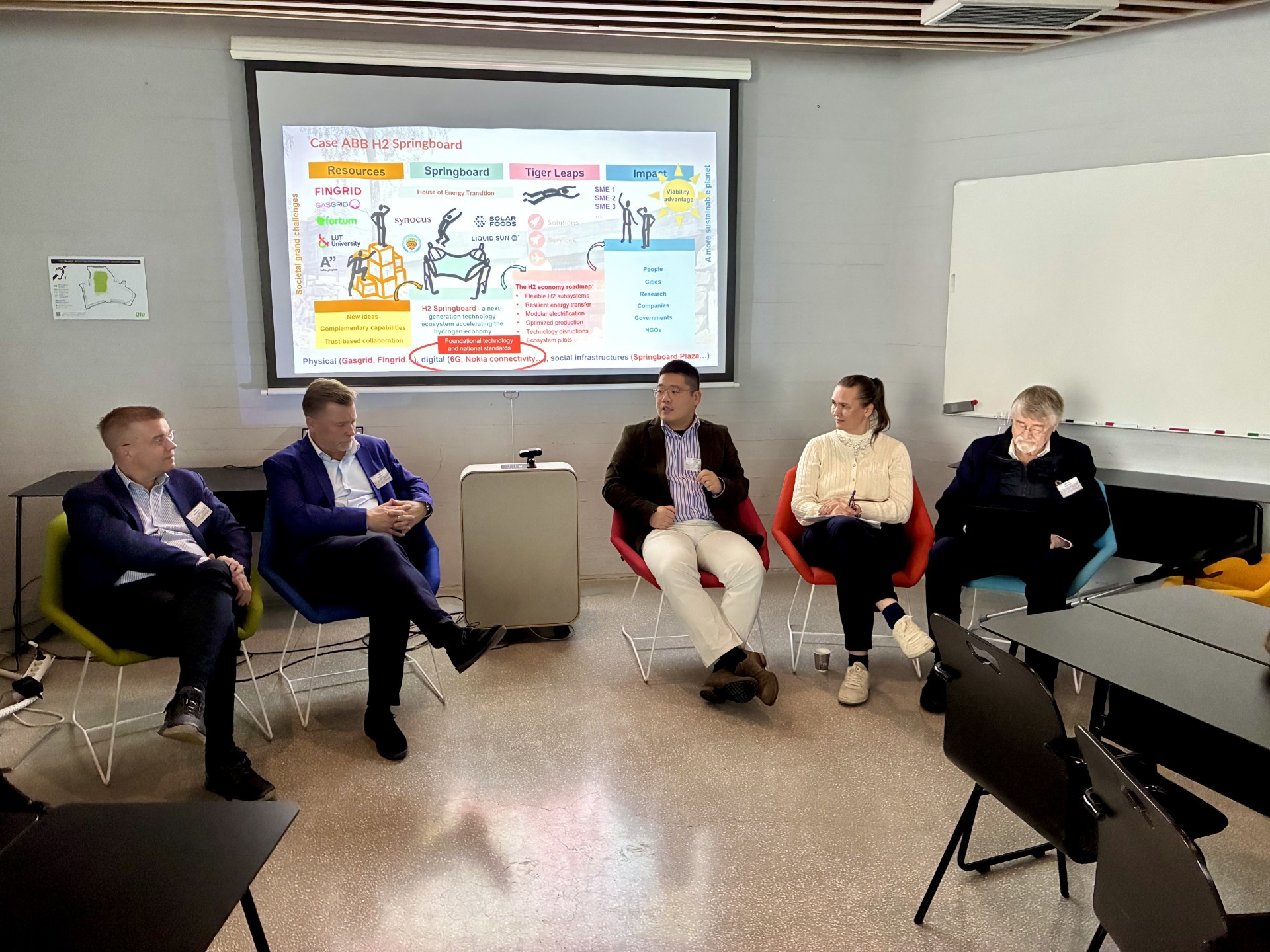
Panelists: Johan Wallin, Managing Partner, Synocus (moderator); Simo Säynevirta, Head of H2 Springboard Ecosystem, ABB; Panu Nordlund, Chief Brand Officer, Liquid Sun; Wenzhong Zhang, P2X Research & Development Manager, Fortum; Mari Lundström, Professor, Aalto University and Co-founder, Elmery; and Markku Markkula, Vice-President, European Committee of the Regions.
The final panel focused on Finland’s ability to turn world-class research and promising innovations into rapidly scaling international success stories. Examples from ABB’s H2 Springboard, Liquid Sun, Elmery, Fortum’s Kalla Test Center, and Espoo Clean Heat illustrated the importance of parallel experimentation, access to test environments, entrepreneurial thinking, and collaboration between startups, large companies, universities, and cities both domestically and internationally.
The discussion called for faster development cycles, greater tolerance for uncertainty, and stronger learning across organizational and disciplinary boundaries. AI should be integrated more systematically into innovation initiatives, while younger generations should be given meaningful opportunities to participate in transformational work. SpringboardX can contribute by connecting different innovation environments, supporting testbeds, and facilitating practical collaboration between the public and private sectors. Attention should be put on smaller companies that often lack access to industrial resources and international networks.
Co-Creating the SpringboardX Agenda
The discussion about the future direction of SpringboardX was set up by Atte Jääskeläinen, President of Sitra, who placed the potential of SpirngboardX in the wider context of Finland’s innovation system. Companies, universities, and research institutions recognize the value of collaboration, but differences in resources, incentives, operating cultures, and time horizons continue to limit its impact.
Overcoming these barriers requires a more systemic approach that connects national policy, research capabilities, growth ecosystems, and concrete market opportunities. Springboards should bring together companies, customers, expertise, and capital, while helping identify and remove bottlenecks to growth. SpringboardX can complement this work by linking local springboards, sharing proven practices, and turning ecosystem-level insights into broader systemic change.
Springboards are not a new phenomenon. In the 1990s, Nokia became a global leader in mobile phones with the support of collaboratively orchestrated springboards in the Helsinki metropolitan area, Tampere, and Oulu. Together with Tekes, VTT, and local universities, Nokia helped accelerate the growth of Finland’s telecommunications sector. This collaboration fostered local communities focused on building capabilities, many of which continue to thrive and contribute to technological breakthroughs through companies such as Oura, ICEYE, and TactoTek.
ASML, one of Europe’s most successful technology companies, has thrived as part of the Brainport innovation ecosystem in Eindhoven, the Netherlands. When Finnish representatives introduced the springboard concept, Brainport executives publicly stated:
“The Springboard concept — company-driven, jointly orchestrated, connecting EU policy to place-based implementation — describes what Eindhoven-Brainport has built organically over more than thirty years.”
We have introduced the springboard concept to highlight the importance of building innovation ecosystems with strong company ownership. Nokia played a crucial role in the success of Finland’s early mobile telecommunications ecosystem. Similarly, ASML, together with Eindhoven University of Technology, has helped develop Brainport into one of Europe’s leading technology hubs.
A springboard brings industrial roadmaps and academic expertise together to co-create a shared vision and roadmap. Partners identify where research capabilities need strengthening and adapt their recruitment and collaboration practices accordingly. In this way, companies gain research partners who can look ahead beyond the immediate business cycle. Researchers, in turn, gain a deeper understanding of industrial needs, helping them attract the right people and develop the right facilities. Throughout this process, societal impact provides a long-term compass, keeping the collaboration anchored in the public interest.
At the Springboard Forum, we agreed that SpringboardX would begin its journey by focusing on the following themes to accelerate innovation and transformation:
- Support existing springboard initiatives by providing a platform for sharing experiences, learning from one another, and jointly building capabilities.
- Strengthen international collaboration by developing partnerships across the Nordic countries, Europe, North America, and Asia.
- Make resilient digital infrastructure a shared priority by turning Finland’s ongoing data centre development into a national innovation platform.
These efforts are already underway, and we are excited to invite additional partners to join us in shaping the agenda of SpringboardX. An example of the urgency of strengthening transformational collaboration is the statement issued by Business Finland two days after the Springboard Forum: Finland is giving away its resources to data center operators on far too modest terms. By asking data centers to make investments of a completely different scale for Finland’s benefit suggests that leading data centers will become springboards – accelerating innovation and transformation.
If you would like to learn more about SpringboardX or participate in our initiatives, we would be happy to hear from you and provide further information.
Please contact Niklas Koski at Synocus:
Email: niklas.koski@synocus.com
Phone: +358 10 212 4730